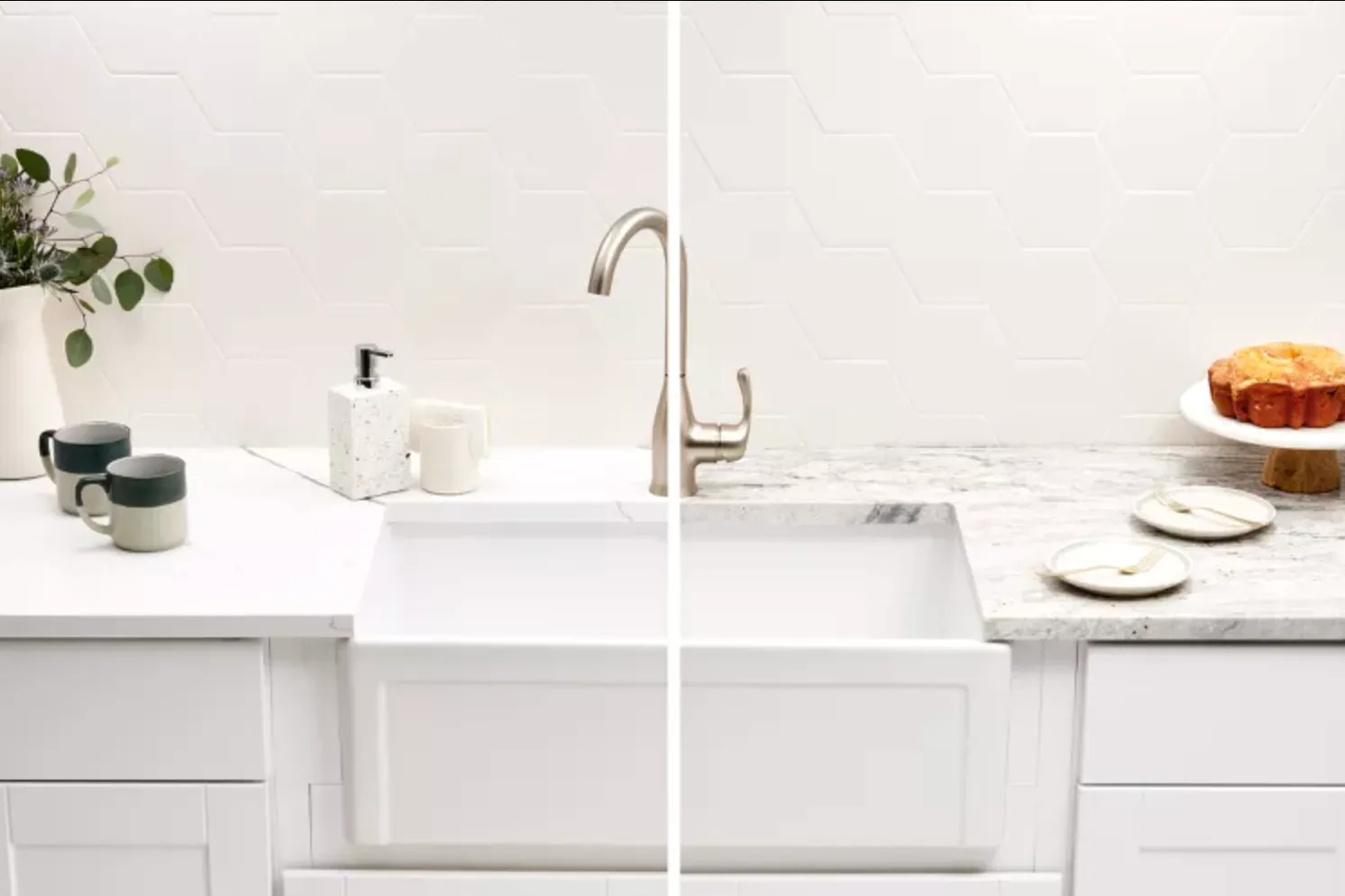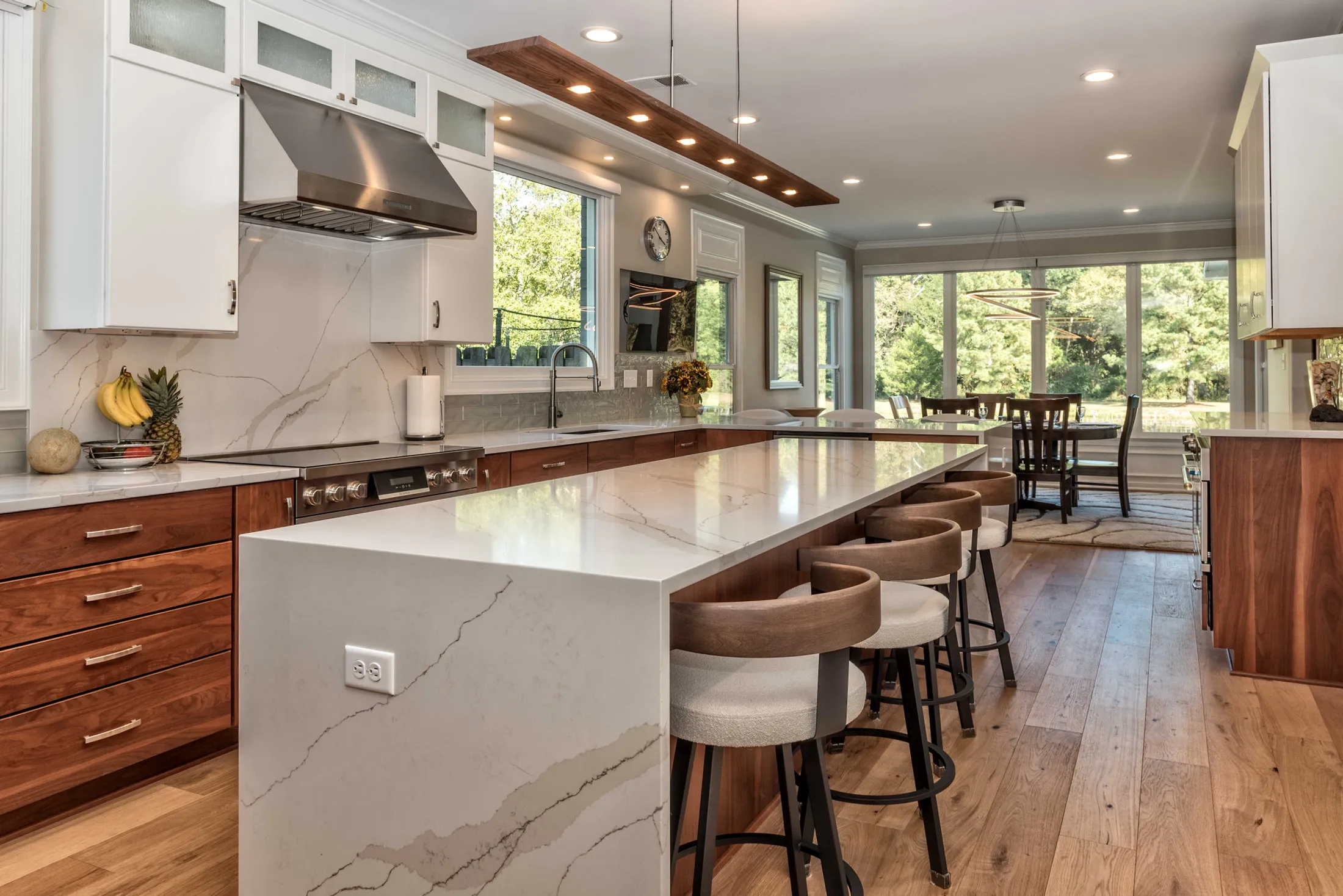
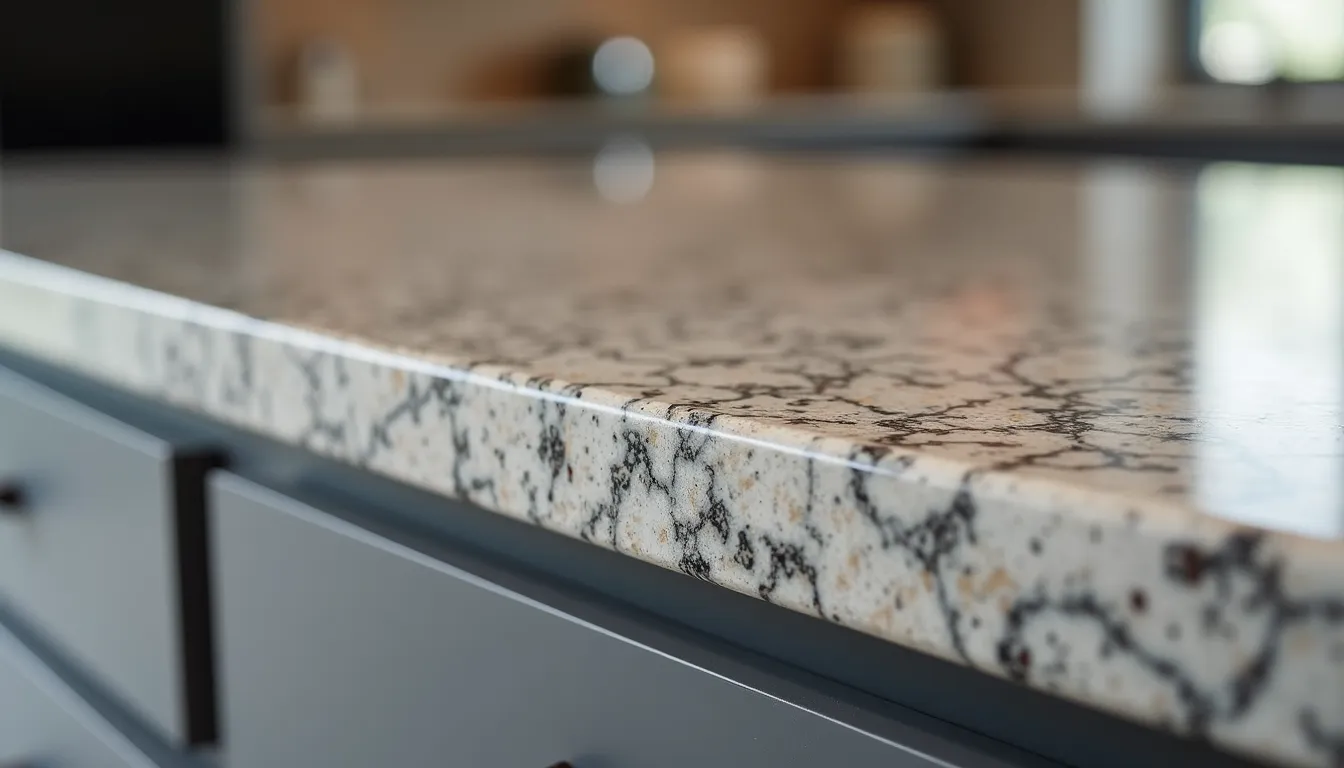
Thickness matters, but mostly for looks, support and overhangs, not for everyday durability. Two centimetres (about 3/4 inch) and three centimetres (about 1 1/4 inches) are the two common thicknesses for stone countertops. A 3 cm top looks more substantial and can usually sit directly on the cabinets. A 2 cm top is lighter and slimmer, may need more support underneath, and is often given a mitred edge so it looks thicker than it is.
Both are strong enough for a busy kitchen when they’re fabricated and installed properly. The right choice depends on the look you want, your layout, and what’s available in the slab you’ve fallen for. Availability varies by product, so always check the specific slab.
What 2 cm and 3 cm actually mean
Stone slabs are made and sold in metric thicknesses. This choice applies to quartz, granite and porcelain; laminate is built differently, on a core, and isn’t chosen this way.
- 2 cm is about 3/4 inch thick.
- 3 cm is about 1 1/4 inches thick.
Porcelain is often produced in thinner slabs than quartz or granite, and its edges are commonly mitred to build up a thicker look. Our post on porcelain countertops explains why thin profiles are part of porcelain’s appeal.
2 cm vs 3 cm at a glance
| 2 cm | 3 cm | |
|---|---|---|
| Approximate thickness | 3/4 inch | 1 1/4 inches |
| Look at the edge | Slim and modern, or built up with a mitred edge | Solid and substantial |
| Support | May need a substrate or extra support, depending on material and layout | Usually sits directly on level cabinets |
| Overhangs | Shorter unsupported spans, so brackets are more likely | Can span further before support is needed |
| Weight | Lighter to carry and install | Heavier |
| Common uses | Vanities, backsplashes, wall cladding, waterfall panels, mitred kitchen tops | Kitchen perimeters and islands |
| Availability | Varies by product and colour | Varies by product and colour |
Does thicker mean stronger?
A thicker slab is stiffer. That matters in a few specific places: across a long dishwasher opening, around a large sink or cooktop cut-out, and on overhangs where stools tuck in. In those spots a 3 cm slab can do more on its own, while a 2 cm slab may need a substrate, brackets or a steel support. Your fabricator will confirm what your layout needs.
In everyday use, though, a properly supported 2 cm countertop handles cooking, cleaning and family life just fine. When a stone countertop cracks, the usual cause is something else: cabinets that weren’t level, missing support under a seam or overhang, or a hard impact on an edge. Level cabinets and solid support matter more than the number on the slab.
How mitred edges change the look
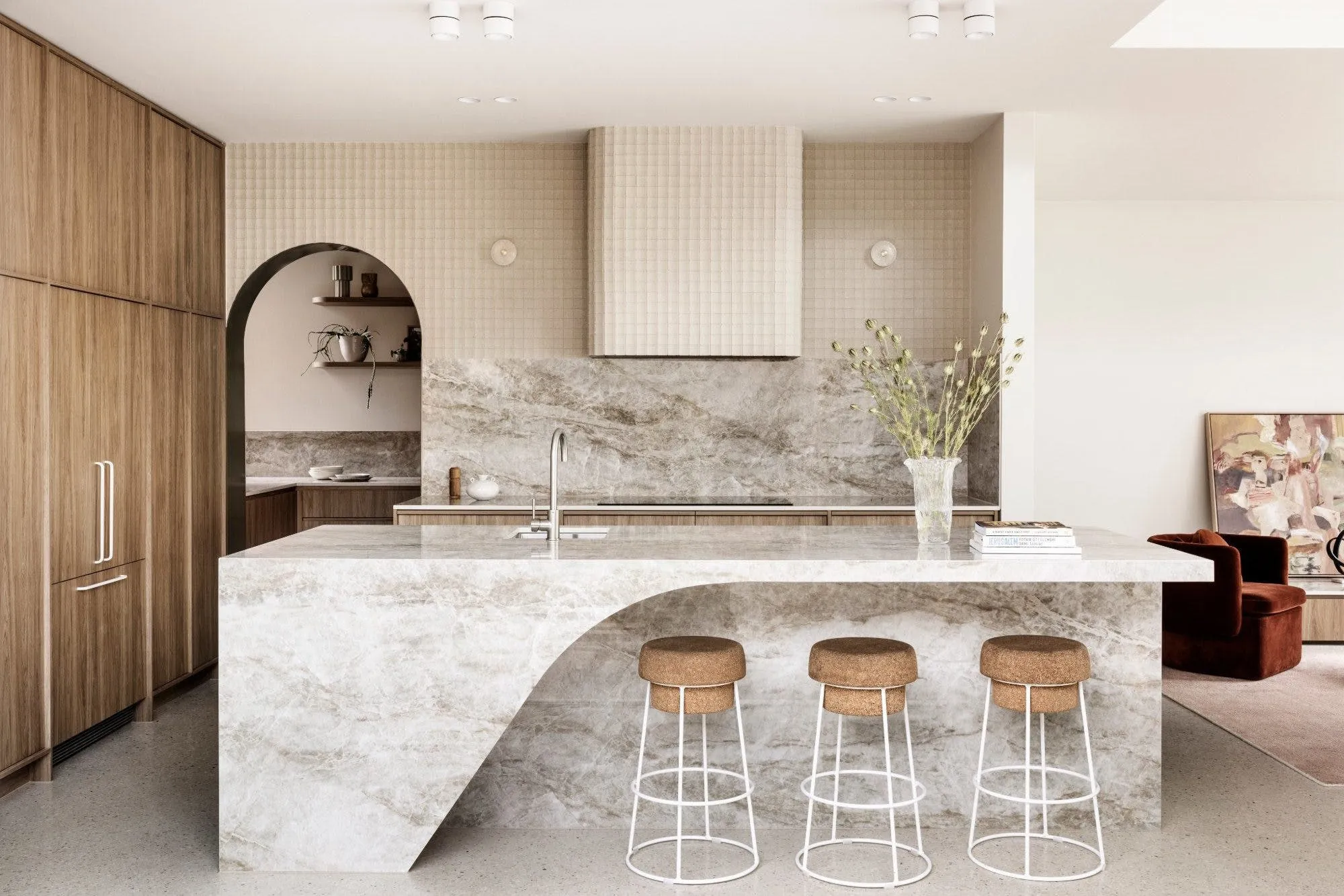
A mitred edge is one of the most useful tools when it comes to thickness. A strip of the same stone is cut and joined to the front edge at an angle, so the joint sits right on the corner and the edge looks like one thick piece.
- A 2 cm top with a mitred edge can look as heavy as a 3 cm top, or heavier, while the main surface stays light.
- A 3 cm top with a mitred edge gives the chunky, slab-like look many people want on an island.
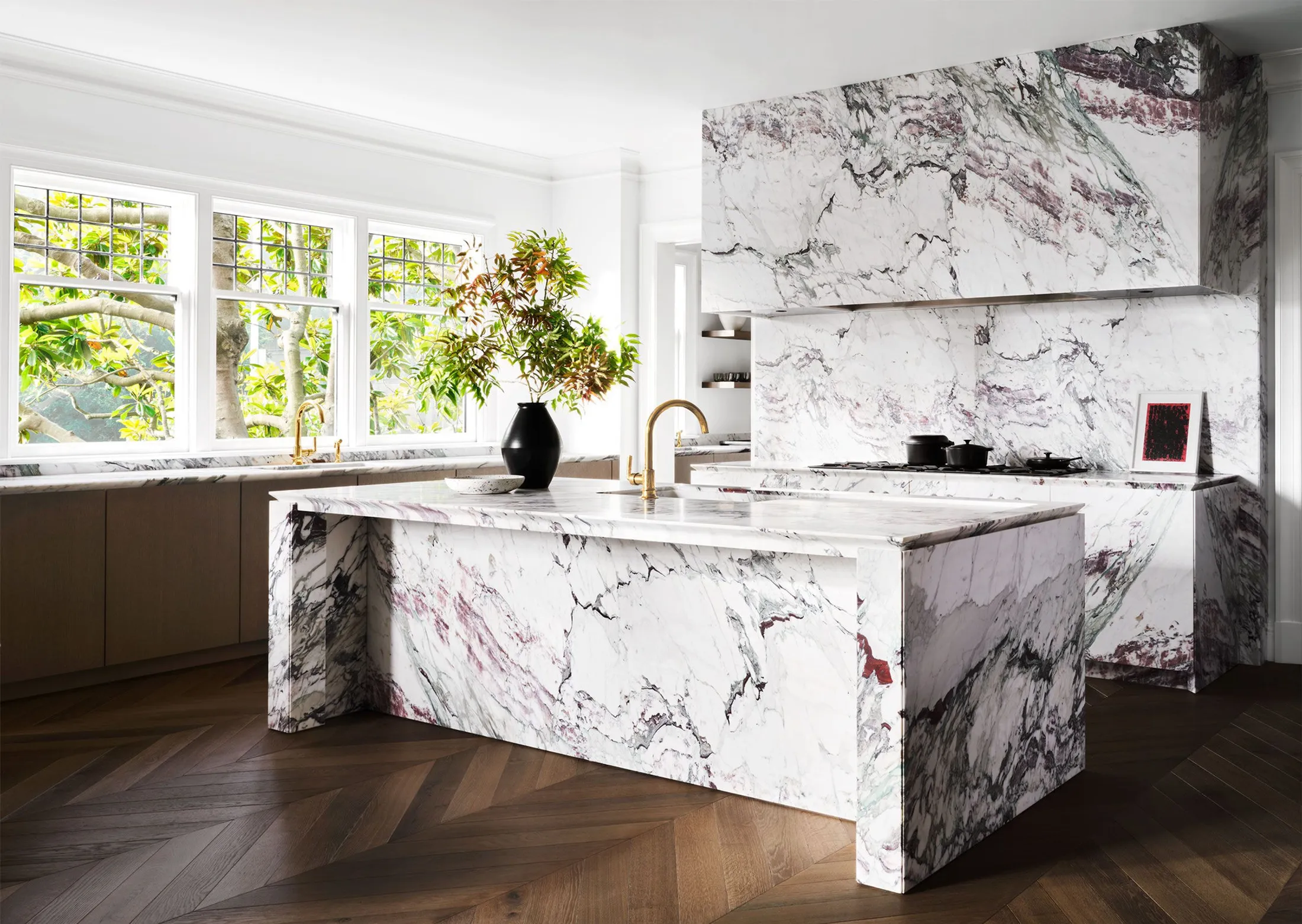
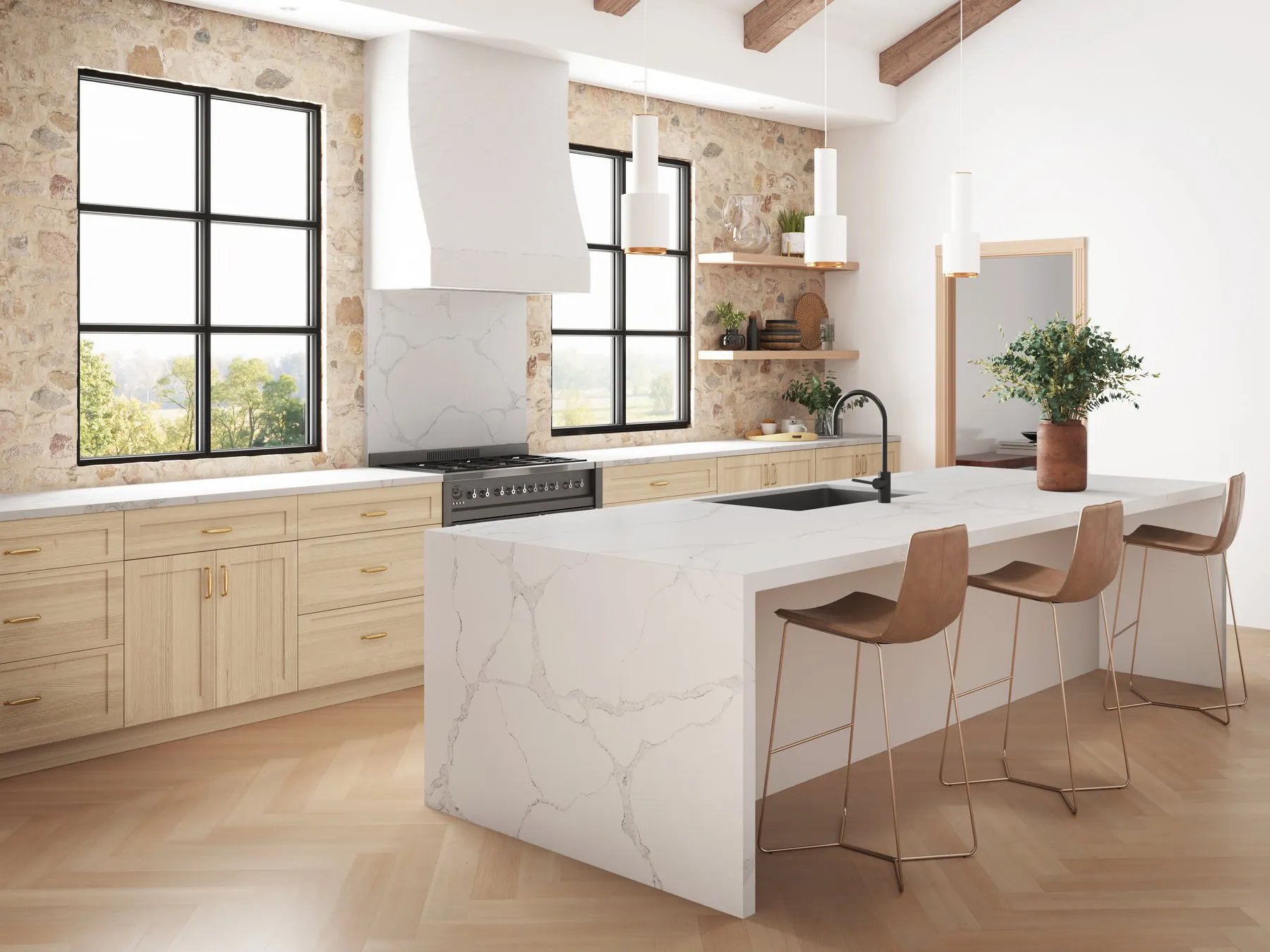
- Waterfall islands use the same kind of mitre to turn the corner and run the stone down to the floor. Our guide to waterfall islands and full-height backsplashes covers that in detail.
A mitre takes careful fabrication so the pattern lines up and the joint stays tight. Our guide to edge profiles compares mitred edges with other common profiles.
Where each thickness makes sense
When 2 cm is a good fit
- Bathroom vanities, where a slimmer top suits the scale of the room
- Full-height backsplashes and wall cladding, where weight and depth on the wall matter
- Fireplace surrounds
- Modern kitchens where a thin, crisp edge is the look you want
- Mitred designs, where the edge is being built up anyway
When 3 cm is a good fit
- Kitchen perimeters and islands, especially with long runs and large cut-outs
- Islands with seating overhangs, where the extra stiffness helps
- Decorative edge profiles like an ogee, which need depth to cut
- Traditional and transitional kitchens where a heavier edge suits the cabinetry
Overhangs and support
Overhangs are where thickness and support meet. A breakfast bar or island seating area leaves part of the stone unsupported, and the safe distance depends on the material, the thickness and the layout. Thicker slabs generally go further before they need help. Beyond that, brackets, corbels or concealed steel supports carry the load. Bring your seating plan to templating so overhangs and supports can be confirmed before anything is cut.
Availability and cost
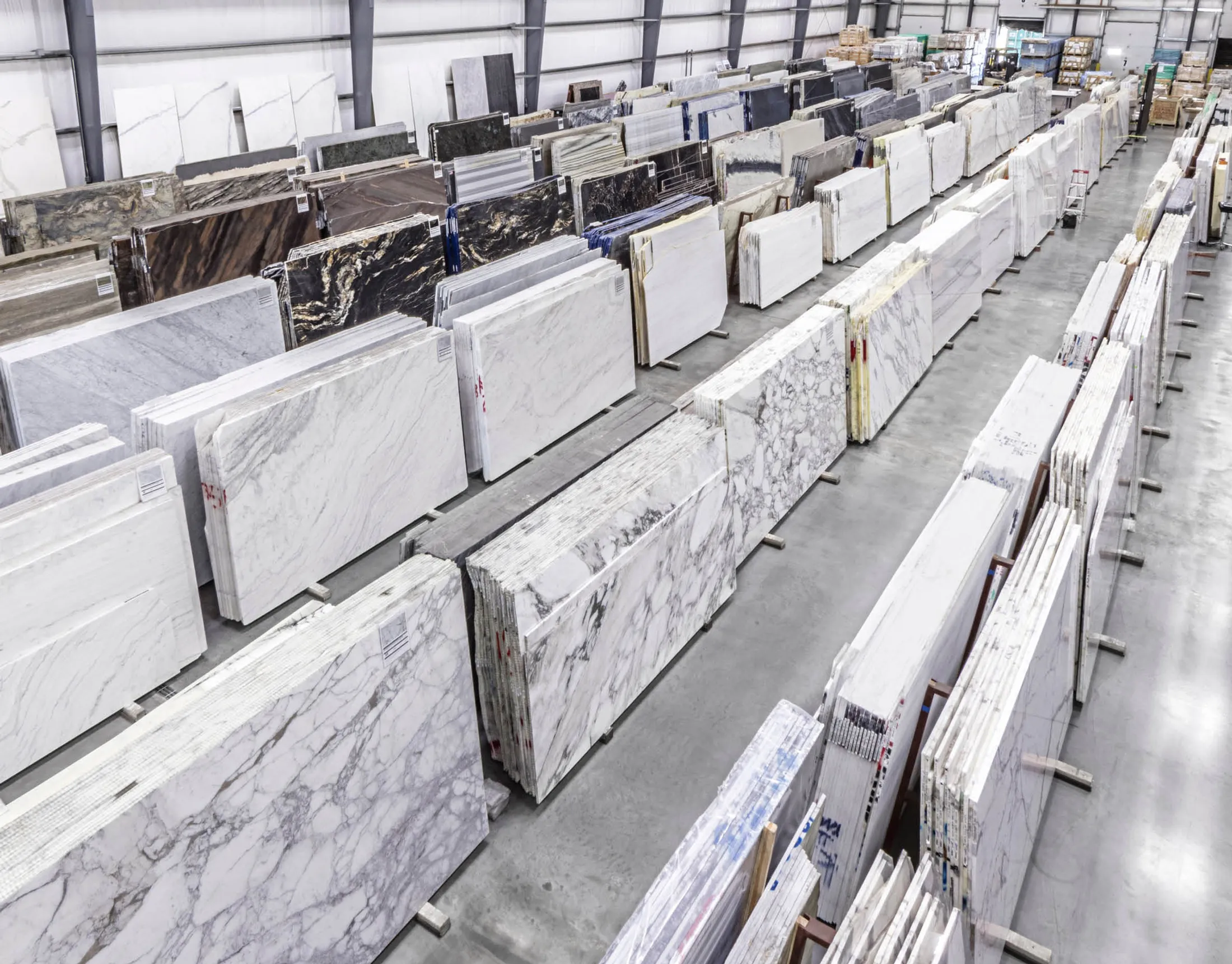
Not every product comes in both thicknesses. Some quartz colours, granite slabs and porcelain lines are only made in one, and stock can differ from supplier to supplier. Before you settle on a thickness, check the specific slab you like in our online Stone Gallery or ask our team. Remnants come in whatever thickness the original slab was, which is worth knowing if you’re shopping remnants for a vanity.
On cost, thickness is one factor among many, and the difference depends on the product, the edge details and the support needed. A 2 cm slab with a mitred edge, for example, adds fabrication work. If you’re undecided, ask for a quote on both, and see countertop cost factors in Waterloo Region for the bigger picture.
How we handle thickness in the shop
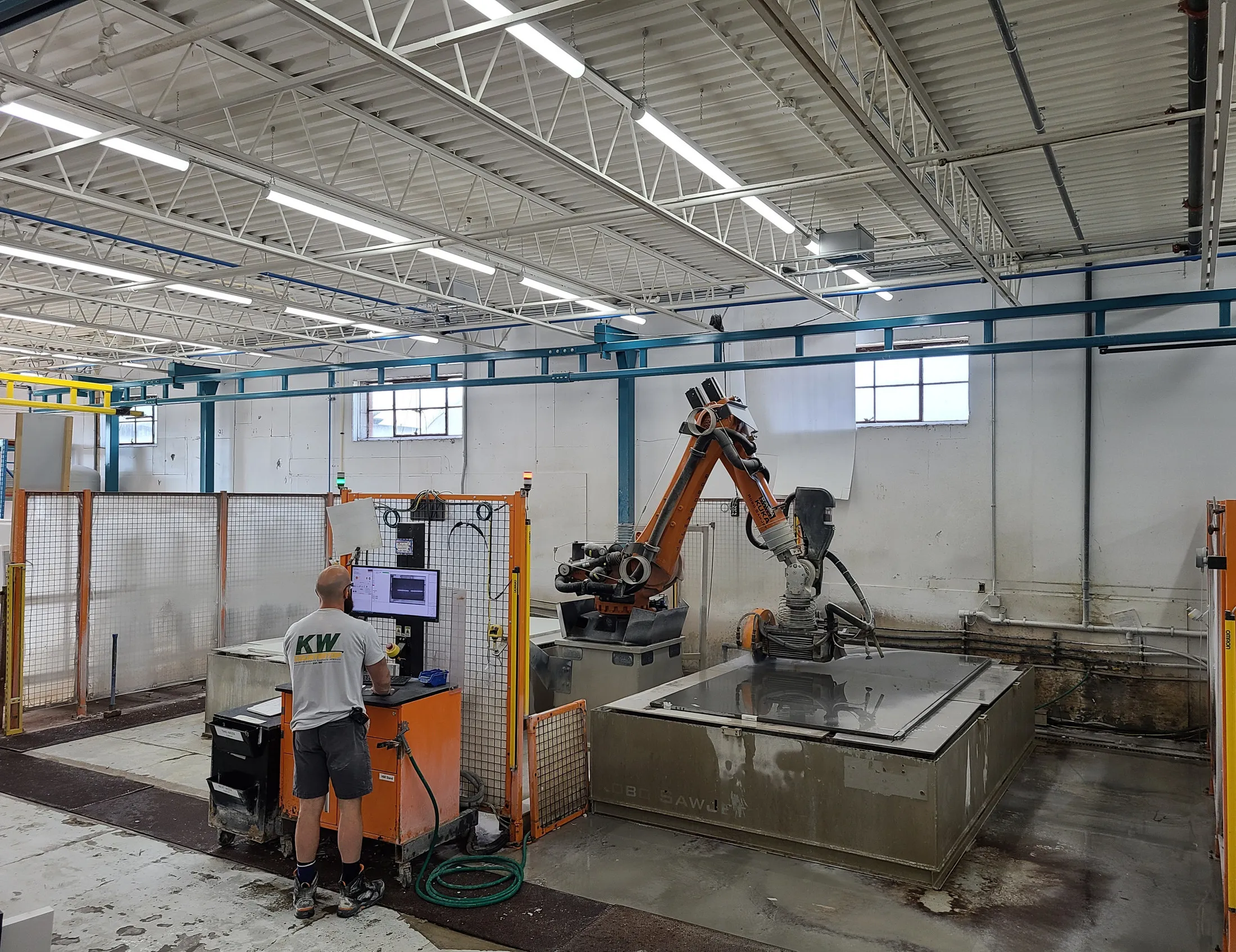
Every top we make is cut and finished in our own production facility in Kitchener, where our BACA Systems Robo SawJet robotic saw cuts slabs to the digital template taken in your home. Mitred edges, cut-outs and polishing happen in the same facility, and our own trained in-house crews install the finished tops. Keeping it under one roof means the people deciding on support and overhangs are the same people who cut and install your countertop. Read more about why local fabrication matters.
So, which should you choose?
- Pick 3 cm if you want a substantial edge, long spans or larger overhangs with less added support, and the slab you like comes in 3 cm.
- Pick 2 cm for vanities, backsplashes and wall applications, for a slim modern edge, or when you’re planning a mitred edge anyway.
- Either way, let the slab lead: choose the colour first, then confirm which thicknesses it comes in.
Homeowners from Kitchener, Waterloo, Cambridge and Guelph can compare slab edges in person at our Kitchener stone gallery. Browse the Stone Gallery online first, then book a visit and we’ll help you weigh up both options.